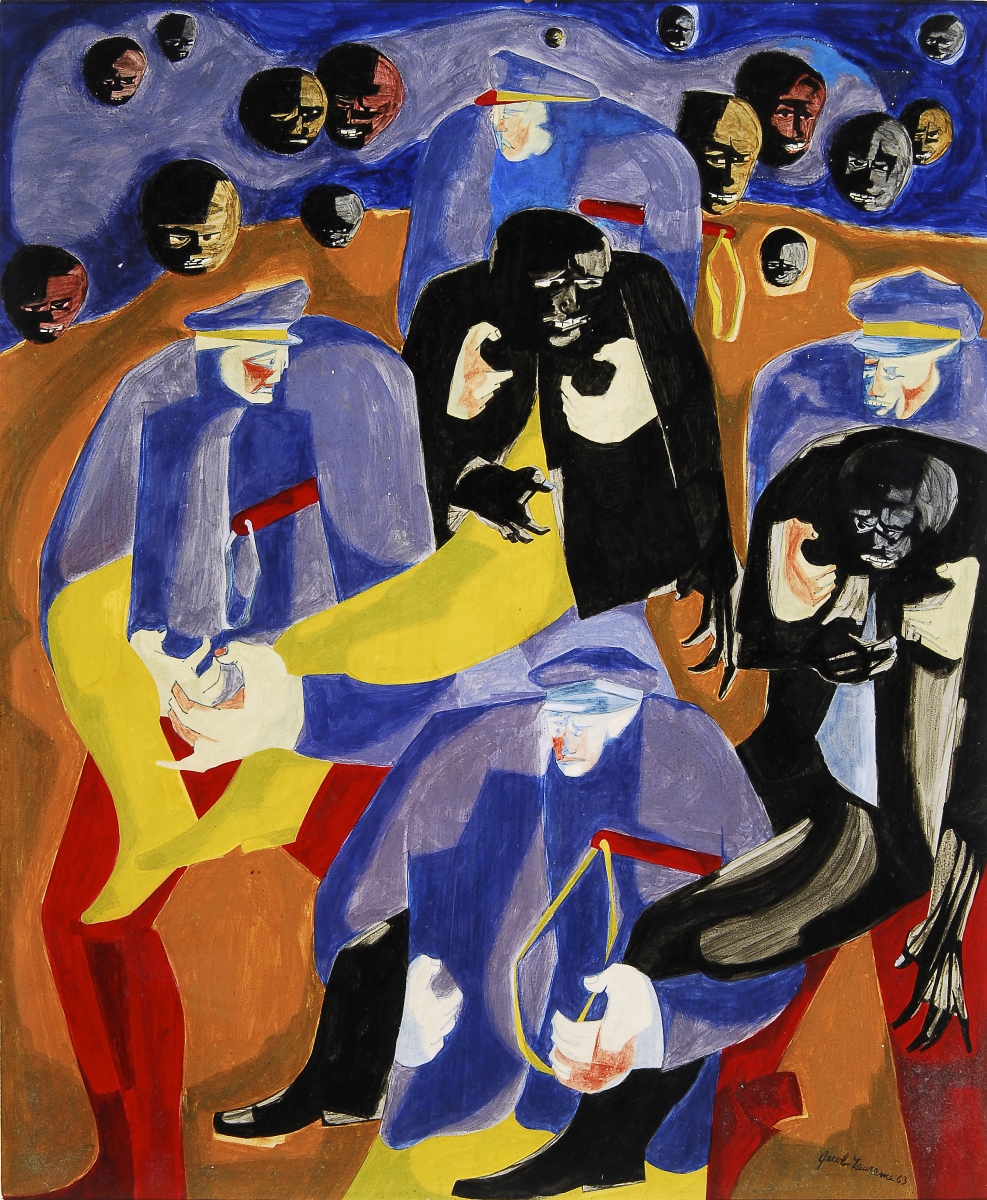
Paintings are a way of seeing history through someone else’s eyes, they are the creator’s expression of the human experience and represent the mental and physical world of humans and their personal interactions with society (cite). Every painting embodies a history. A history of what the artist was thinking, feeling, seeing in the society at that time; a history of how they created the painting- their techniques, materials, where it has been, how it has traveled all tell a story. Paintings also tell a history of how society through time has responded to the art- what were other artists painting, who were the critics, and how did the public interpret it through the years?
Think of a painting as a historical interpretation. Artists use various process, techniques and abstract concepts to illustrate life through their own experience and perspective, they have a specific reason for creating the painting, but they also make a space for you to create your own meaning. Researchers characterize art in many different ways:
- A creation, a cultural artifact that is an embodiment or an expression of the creator’s views and emotions. (cite),
- A visual product and process that is personal and unique (cite) and
- An experience created by its aesthetic capacity to elicit emotions and questions that engage Individuals in their own unique ways (Greene 1991).
In this module you will:
Explore how the experiences of two artists influence their interpretation and response to the Plessy v. Ferguson 1896 ‘Separate but Equal’ doctrine in the 1940’s and 1960’s by:
- Using artistic conventions and codes as clues to interrogate the representation of Plessy v. Ferguson in the artwork.
- Interpreting symbolic meanings of the work to ‘read in-between the lines” to see what the artist is trying to say about “Separate but Equal” doctrine.
- Placing the artwork in a larger historical context and make an argument for its place- as an object and as a creation in that the decades surrounding the Plessy v. Ferguson 1896 court case..
The Activity
Explore the works of two American artists Norman Rockwell (1894-1978) and Jacob Lawrence (1917-2000) and share how their experiences influence their interpretation of the impact that the Plessy v. Ferguson, 163 U.S. 537 (1896) landmark case had on life and experiences of Americans in the decades following the court ruling.
Pre-Reading: These sources will tell you a little about the lives of these two famous artists.
| NORMAN ROCKWELL | JACOB LAWRENCE |
| Without thinking too much about it in specific terms, I was showing the America I knew and observed to others who might not have noticed. —Norman Rockwell | It wasn’t all happiness, it wasn’t all peace. There was struggle, and I would say that through this struggle developed a certain kind of beauty. ––Jacob Lawrence |
| Norman. Rockwell- A brief Biography. The Norman Rockwell Museum. “Norman Rockwell Reminisces“. Interview ( Audio 12mins) | About Jacob Lawrence. Jacob Lawrence: The Migration Series Lawrence on his Familial Ties with the Migration Series.Jacob Lawrence:The Migration Series Lawrence on Growing Up in the Harlem Community. Jacob Lawrence:The Migration Series |
Pre-Readings- These readings will help you analyze the paintings.
Toledo Museum of Art. Visual Literacy: The Art of Seeing Art.
Glass, Dr. Robert. Introduction to Art Historical Analysis
Look at the following paintings. What events or issues are the artists portraying in the paintings? how do you know?
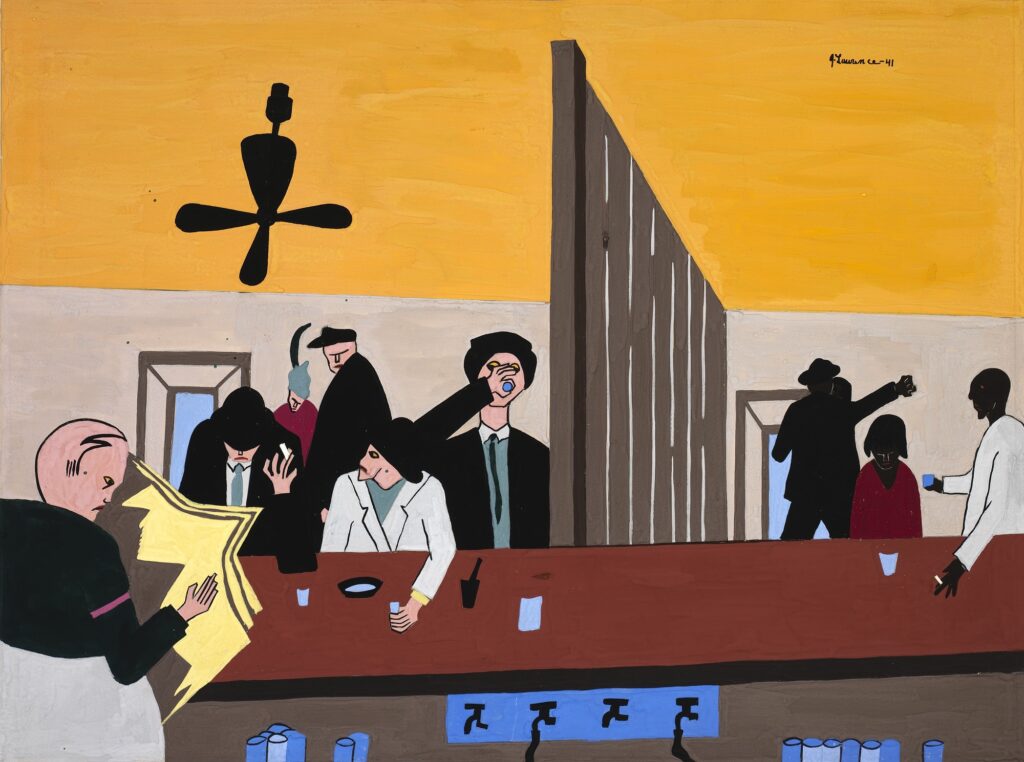
Jacob Lawrence, 1941. Bar and Grill. Gouache on paper. 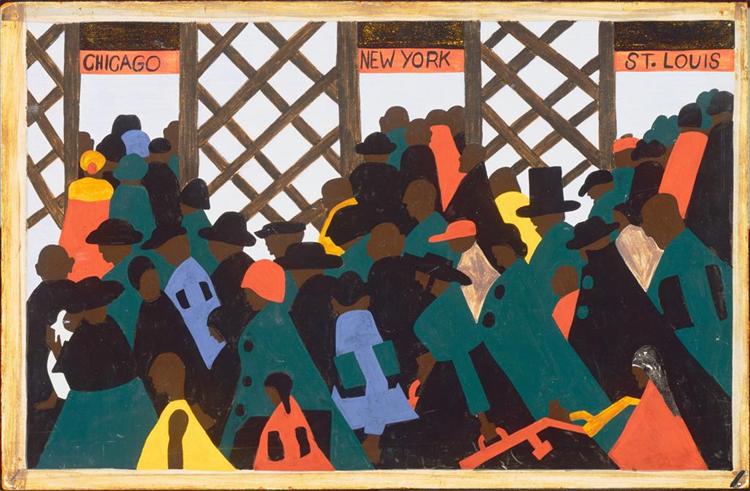
Jacob Lawrence. 1940/41.The Migration of the Negro. Panel 1. Casein tempera on hardboard, 12 x 18 in. 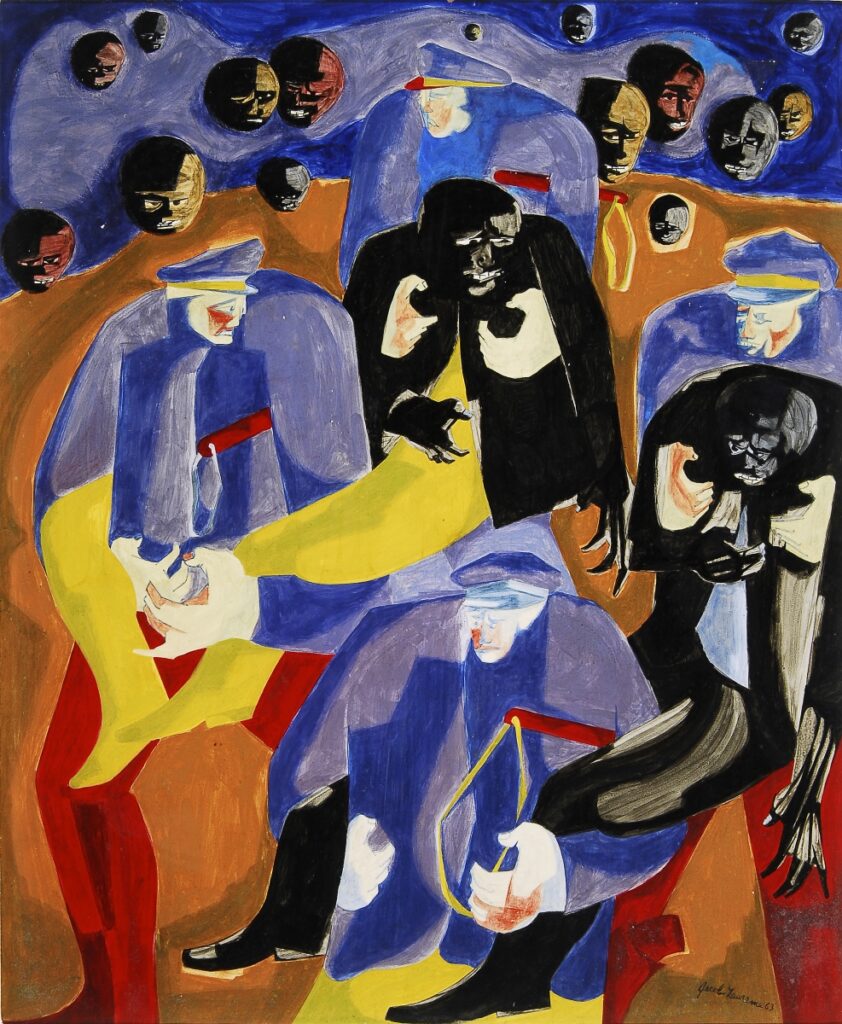
Jacob Lawrence. 1963. Two Rebels. Casein tempera on hardboard, 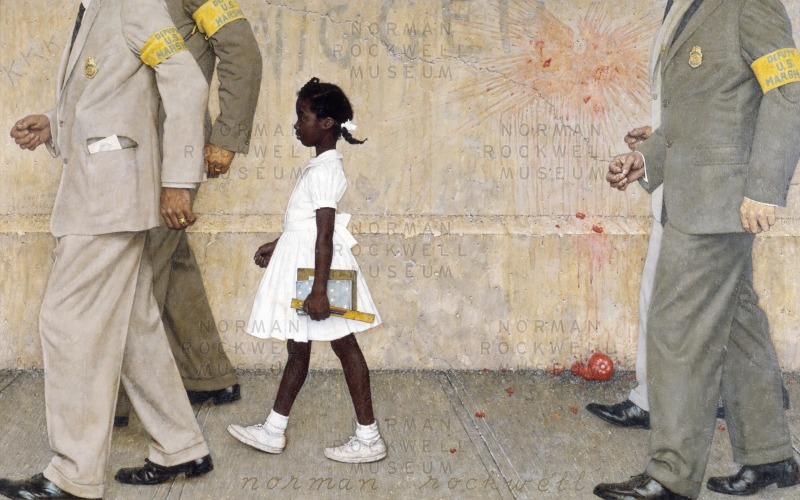
Norman Rockwell. 1964. The Problem We Live With. Oil on Canvas. 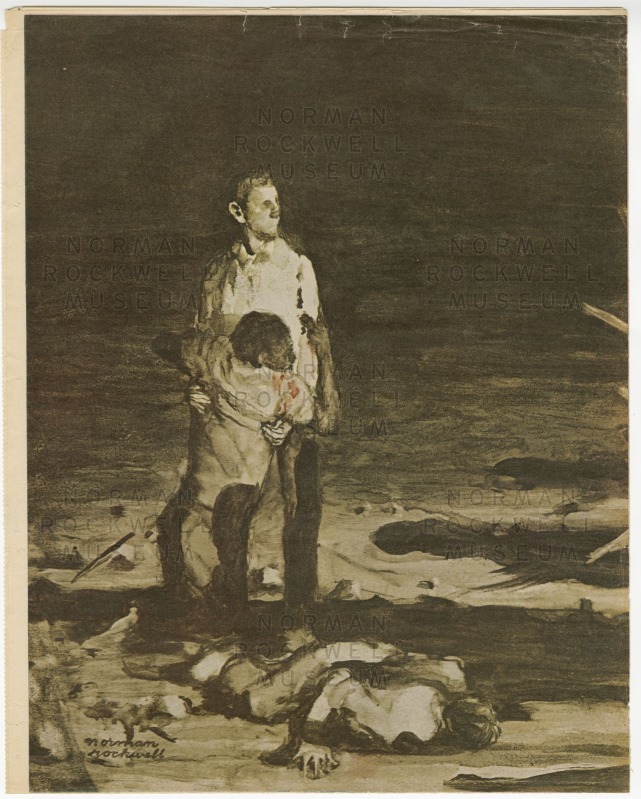
Norman Rockwell. 1965 Murder in Mississippi. Oil on Canvas. 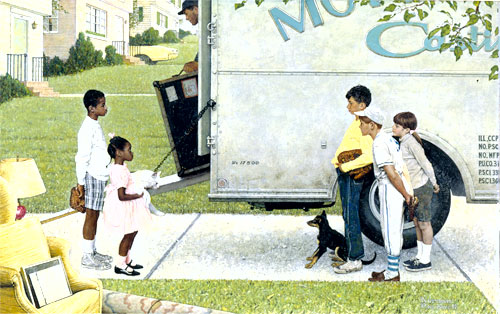
Norman Rockwell. 1967. New Kids in the Neighborhood. Oil on Canvas
Now take a closer look at the paintings. Explore the techniques and approach the painters take to represent the message.
Use this evidence from the paintings to explain how you think Rockwell and Johnson felt about the notion of “Separate but Equal”. How did their personal experiences influence their telling of the story?
Jacob Lawrence. (1917-2000)
Norman Rockwell. (1894-1978). Paintings
-
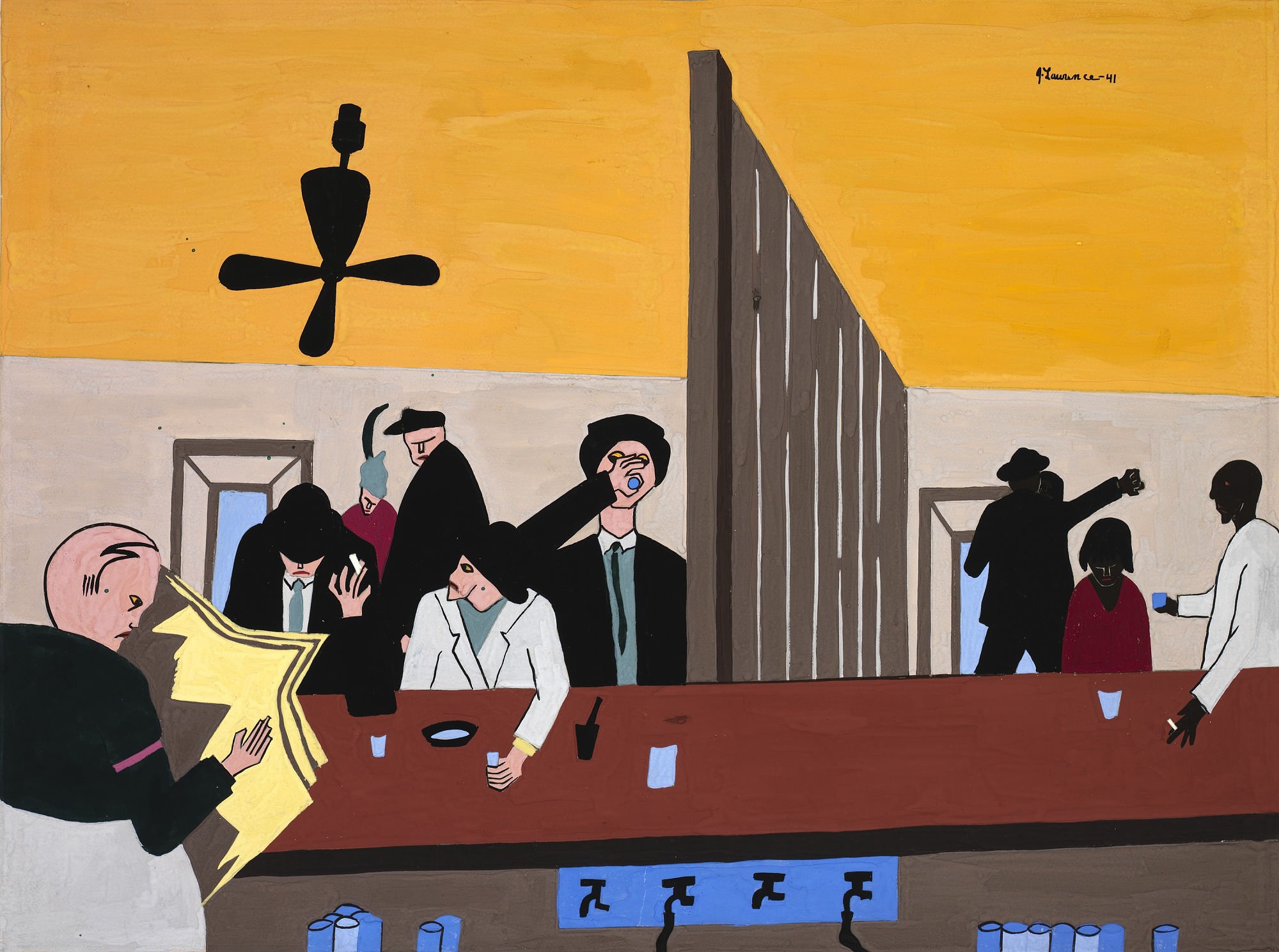
Jacob Lawrence. (1917-2000)
Bar and Grill, 1941
gouache on paper, Smithsonian American Art Museum, Bequest of Henry Ward Ranger through the National Academy of Design, 2010.52
.
The Great Migration. Panel 1. 1941.
1940-41, Casein tempera on hardboard, 12 x 18 in. The Phillips Collection, Washington, DC, Acquired 1942.
Two Rebels 1963.
1940-41, Casein tempera on hardboard, 12 x 18 in. The Phillips Collection, Washington, DC, Acquired 1942.
Explore the works of Jacob Lawrence at Museum of Modern Art and Jacob Lawrence The Migration Series
Use the following guiding questions to help you analyze the paintings
Conventions:
• Using different colors, especially those that contrast, can communicate how one may feel about a person, event, or idea. How does the artist use color to enhance the message, to convey their emotions? How do these colors influence your interpretation of the message?
• Examine how the surrounding features create a frame around the main focus of the picture. Who/what does the artist focus on? What message does this convey? What is the relationship between the main focus and the other images in the painting?
• Amounts of light and dark can present information regarding something that occurred or will happen in the future. Does the artist use light in a creative way to covey a thought/message?
• Positioning and facial expression can communicate how a subject feels within the photo, drawing, or painting. How does the artist use body language to tell a story? What is the artists attitude towards their subjects?
Symbolism:
• What symbols does the artist use to make implications about the society?
Creation:
• How do the size, shape, height, and location of the painting structure your perception? Try to imagine the painting in a different size, shape. How would that change your perception and interpretation?
• How does the experience of the artists influence their style and techniques?
Contextualization:
• What are the themes that emerge from these paintings of the everyday life of the Subjects? What do the techniques used reveal about the historical period?
• Are there omissions in the artist’s work that reveal information about the time period?
• How has the politics influenced the art?
• What is the creator's first-hand voice?
-
-
Norman Rockwell. (1894-1978). Paintings
The Problem We All Live With. 1963
Oil on canvas
Search the Norman Rockwell Museum Digital Collection for details on the creation process for the Problem We Live With paintings.
Murder in Mississippi (Southern Justice). 1965
Oil on canvas
Search the Norman Rockwell Museum Digital Collection for details on the creation process for the Murder in Mississippi paintings.
New Kids in the Neighborhood. 1967
Oil on canvas
Search the Norman Rockwell Museum Digital Collection for details on the creation process for the New Kids in the Neighborhood painting.
Use the following guiding questions to help you analyze the paintings
Conventions:
• Using different colors, especially those that contrast, can communicate how one may feel about a person, event, or idea. How does the artist use color to enhance the message, to convey their emotions? How do these colors influence your interpretation of the message?
• Examine how the surrounding features create a frame around the main focus of the picture. Who/what does the artist focus on? What message does this convey? What is the relationship between the main focus and the other images in the painting?
• Amounts of light and dark can present information regarding something that occurred or will happen in the future. Does the artist use light in a creative way to covey a thought/message?
• Positioning and facial expression can communicate how a subject feels within the photo, drawing, or painting. How does the artist use body language to tell a story? What is the artists attitude towards their subjects?
Symbolism:
• What symbols does the artist use to make implications about the society?
Creation:
• How do the size, shape, height, and location of the painting structure your perception? Try to imagine the painting in a different size, shape. How would that change your perception and interpretation?
• How does the experience of the artists influence their style and techniques?
Contextualization:
• What are the themes that emerge from these paintings of the everyday life of the Subjects? What do the techniques used reveal about the historical period?
• Are there omissions in the artist’s work that reveal information about the time period?
• How has the politics influenced the art?
• What is the creator's first-hand voice?
-